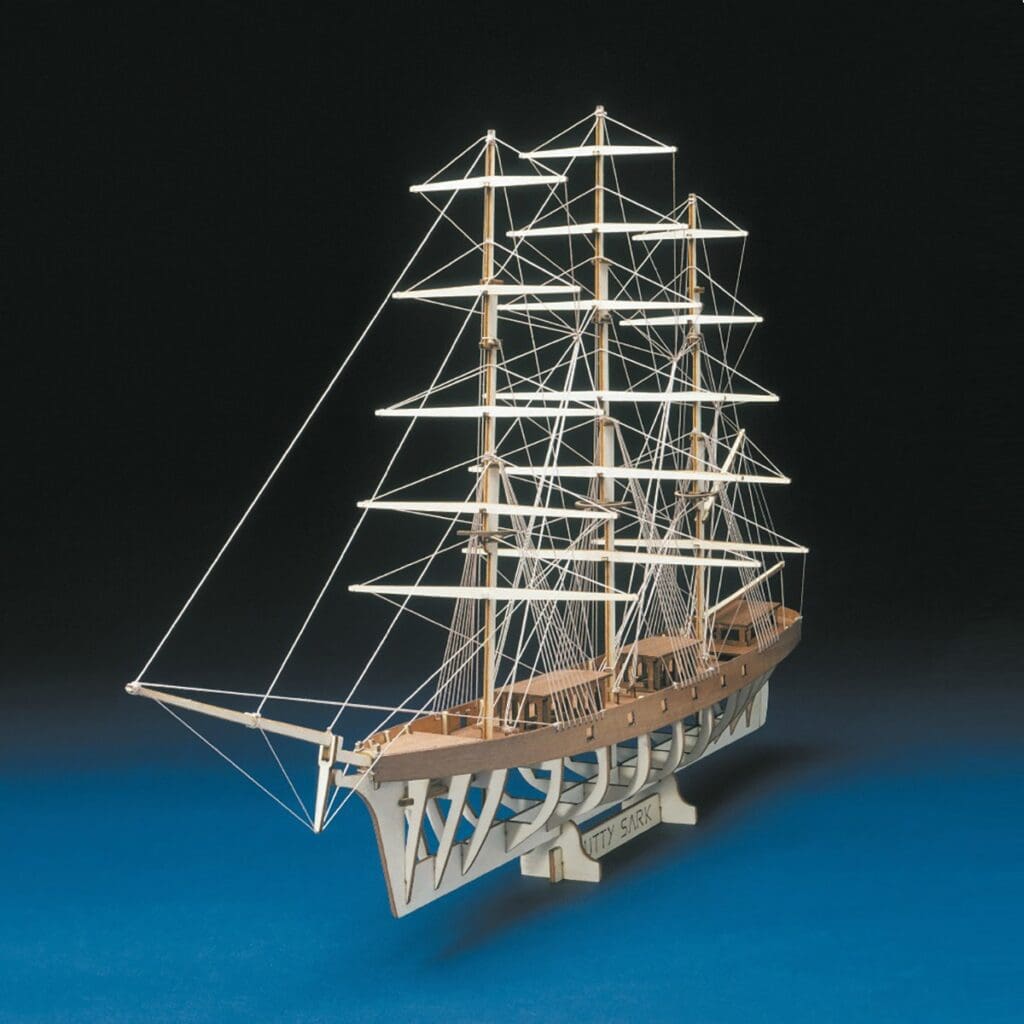
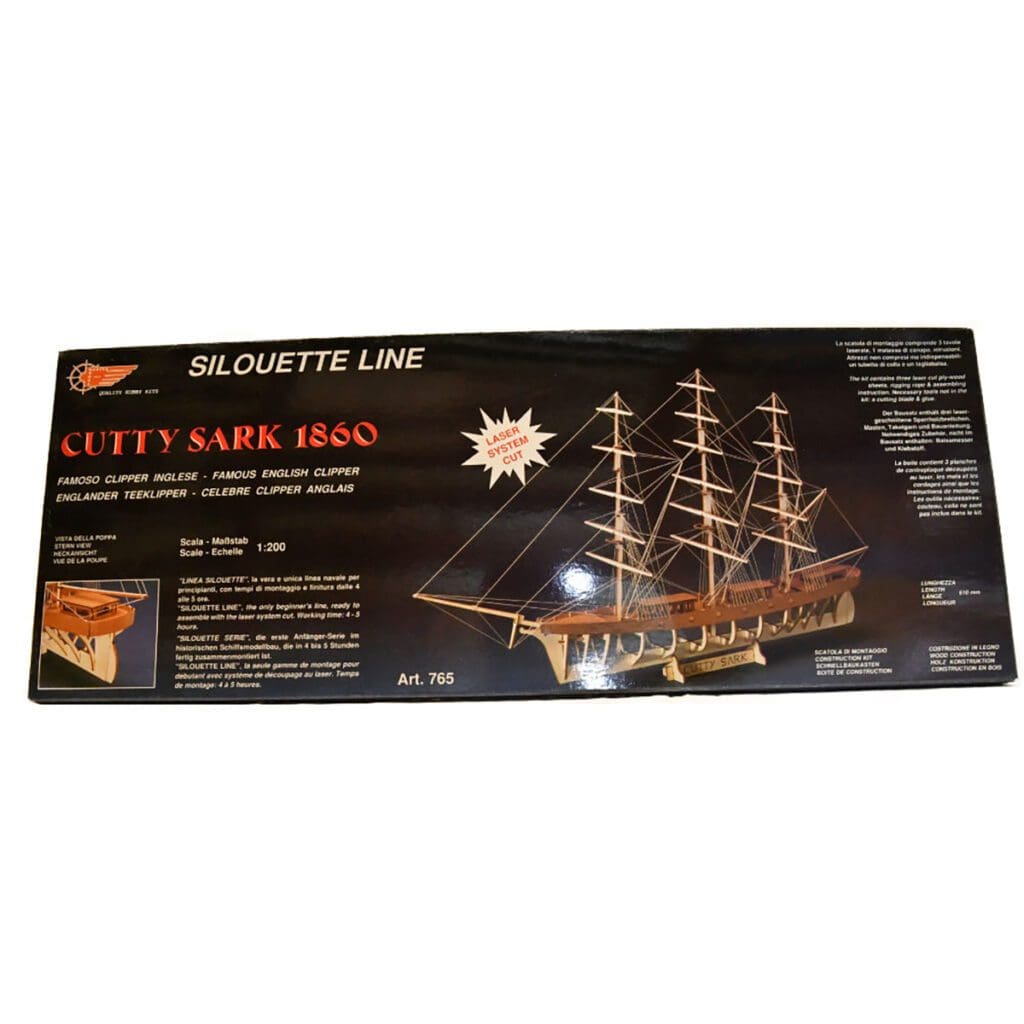
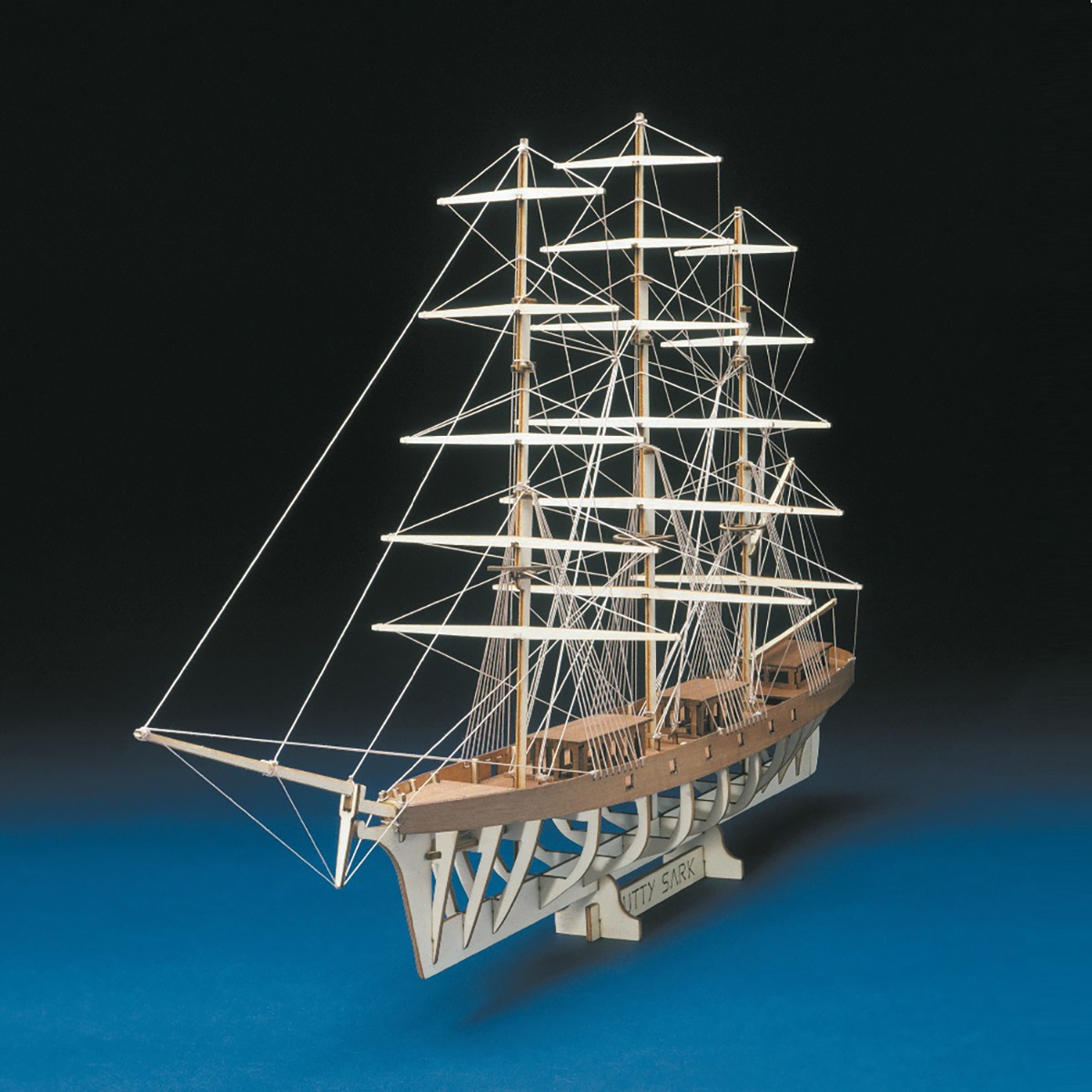
Technical details:
- DIMENSIONS: 62 cm
- SCALE: 1:200
- MATERIAL: wood
- PACKAGING: supplied in a cardboard box suitable for safe transport.
- DIFFICULTY LEVEL: *
- PRODUCT DESCRIPTION: Mantua offers a wide range of products. Building a silhouette model introduces the basics of hull construction and rigging. Thanks to their natural materials, completed Mantua models can rival the appearance of more complex models. The kit includes laser-cut components, rigging and photographs that guide you through the work step by step.
All you need is a hobby knife, glue and a few hours of free time. - HISTORY: Cutty Sark, part of the World Heritage setting, is the only tea clipper to have survived for posterity. She is one of the world’s most famous sailing ships, alongside Admiral Nelson’s immortal Victory. The roughly thousand-ton Cutty Sark was launched in Scotland on 23 November 1869. Built in Dumbarton to Hercules Linton’s designs for Jock Willis, her name comes from Robert Burns’s poem Tam O’ Shanter. The witch in the poem wears a revealing short shirt, a “cutty sark”. This inspired the ship’s name, although the precise reason remains unclear.
In the 19th century, Cutty Sark, like many other ships, brought exotic goods to Britain from colonial countries. She is a fine example of an English composite-built clipper. Clippers had three masts and full rigging; carrying as many as fifty sails was not unusual. In her prime, she was the fastest of them all.
Cutty Sark was designed for speed to compete in the growing and highly profitable tea trade. A crew’s reputation depended on which ship brought the new season’s first tea cargo from China to London. Speed mattered: the first arrival earned a special reward and a major trading advantage. Steamships later displaced the clippers after the Suez Canal opened, reducing the voyage from almost 3–4 months to 60 days. Steamers could take the much shorter route, while sailing ships still had to round the Cape of Good Hope. After eight years carrying tea and five carrying coal, Cutty Sark’s greatest successes came in the Australian wool trade. Her unusually curved, narrow hull and large sail area enabled repeated speed records. In 1883, she completed her first Sydney–London voyage in 82 days, reducing this to 73 days in 1885. She left eight clippers behind, including her great rival Thermopylae. She also took sweet revenge on the triumphant steamships by overtaking the Sydney-bound Britannia at 18 knots under full sail.
By the end of the century, sail nevertheless gave way to steam. Most sailing ships, including clippers, had surprisingly short working lives, often only ten years. Many were lost in maritime accidents or fires. With the arrival of steamships, others were relegated to lower-paying cargoes. The last survivors ended their days as floating storage or coal hulks serving steamers. Cutty Sark had a different fate. After years under the Portuguese flag, senior British naval officer and sailing enthusiast Wilfred Dowman bought her back in 1922 and restored her as a training ship. In 1954, after an enviable 84 years of service, she finally took her place in dry dock at Greenwich, London, as part of the National Maritime Museum.
On 21 May 2007, the ageing clipper was nearly lost in a fire caused by a vacuum cleaner left running aboard. Fortunately, restoration was already underway, so most priceless objects from the hold, along with the masts, steering wheel and famous figurehead, had been removed. The fire nevertheless added £10 million to the £25 million restoration cost. Although the hull suffered serious damage, the Cutty Sark Trust responsible for the monument considered it repairable.
We recommend
Ideal for beginners: experience the satisfaction of building a real ship model and testing your skills without being discouraged by overly difficult tasks. Also suitable for experienced modellers: small modifications and more refined materials can produce highly sophisticated models. An imaginative gift for children: assembling a first model develops imagination, manual dexterity and precision. Valuable for schoolchildren: the materials offer excellent opportunities to develop practical skills.