The sextant is a distinctive instrument of traditional marine navigation. It measures the angle between two directions. In celestial navigation, that is usually the angle between a celestial body and the visible horizon.
From reflecting instruments to the sextant
The reflecting octant was a predecessor of the modern sextant. The independent work of John Hadley and Thomas Godfrey in the early 1730s marked an important stage in the development of angle-measuring instruments for use at sea. The sextant developed from this family of reflecting instruments.
Latitude and longitude
Latitude is measured north or south of the Equator, from 0 to 90 degrees. Longitude is measured east or west of the Greenwich prime meridian, up to 180 degrees. Together, these coordinates describe a geographical position.
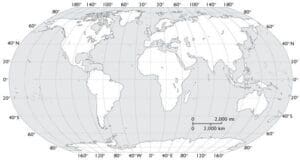
From an angle measurement to a position
Using the mirrors, the observer brings the image of a celestial body into alignment with the horizon and reads the angle. That reading is not a complete geographical position. Accurate observation time, astronomical data and measurement corrections are also needed.
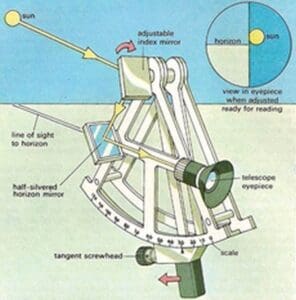
A reduced altitude observation can provide a line of position; further observations and navigational calculations are used to establish a fix. Refraction, instrument error and the conditions in which the horizon is observed can affect the result. Fine scale divisions alone therefore do not guarantee a particular positional accuracy.
Measuring horizontal angles
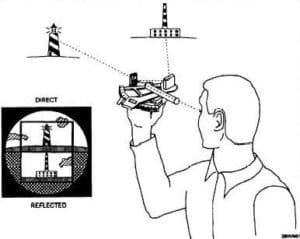
A sextant can also measure horizontal angles between known coastal landmarks. This is a different procedure from observing the altitude of a celestial body above the horizon.
A maritime keepsake or a navigation instrument?
When browsing our sextant selection, check the intended use of each item. A decorative object should not be assumed to offer the accuracy of an instrument suitable for navigation. Explore our nautical home decor ideas, or contact us with a product question.
Források / Sources / Quellen: U.S. Naval Institute: The Evolution of the Sextant; U.S. Naval Observatory: Celestial Navigation Data.