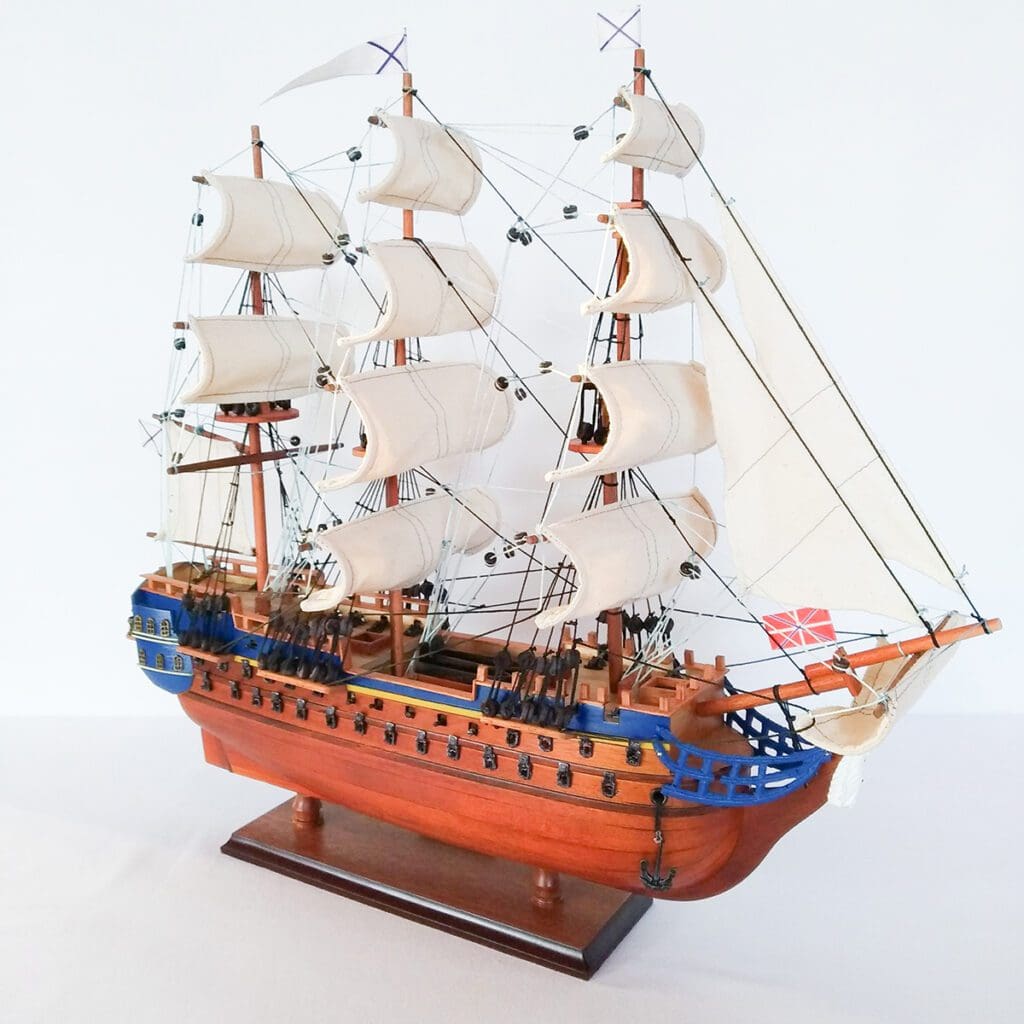
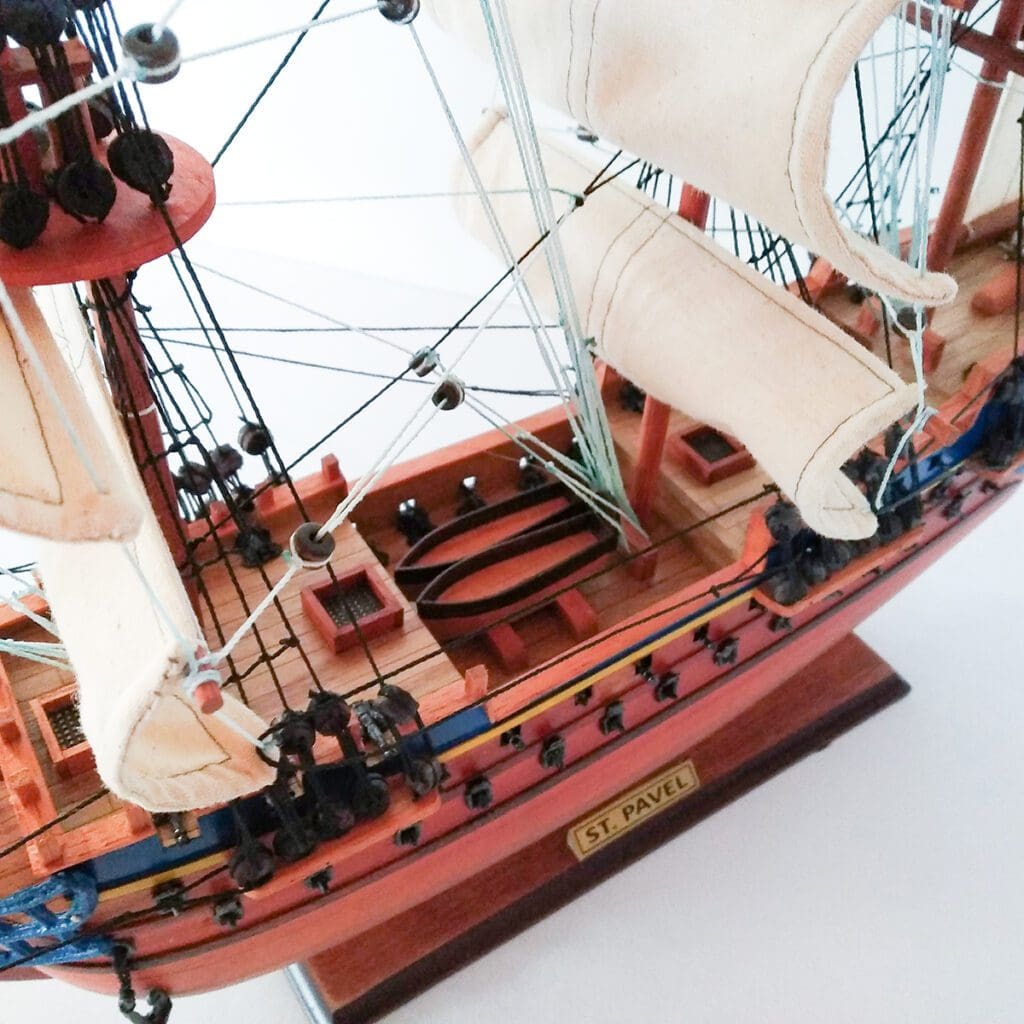
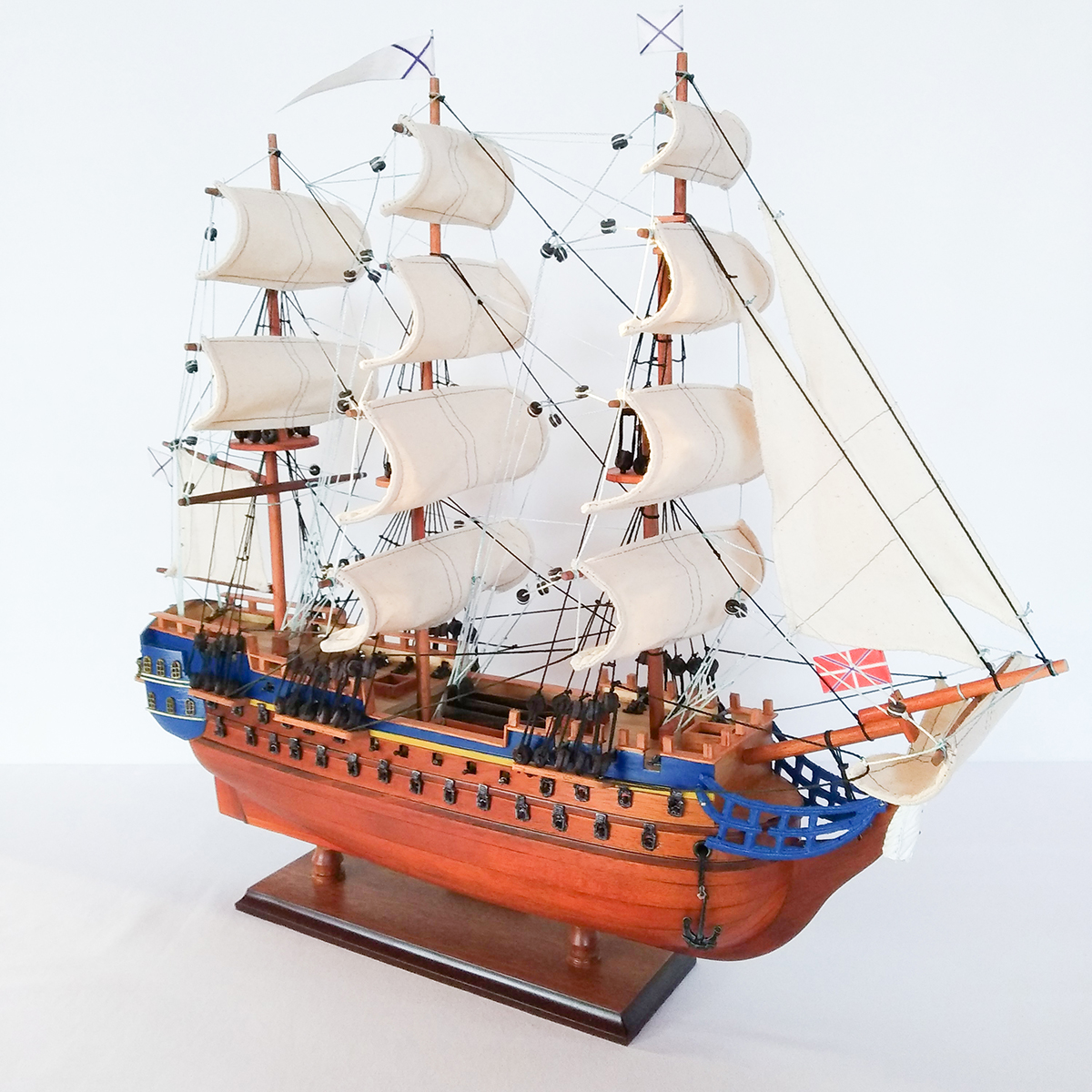
St. Pavel sailing ship model
Product information:
- SIZE: 48 × 18 × 45 cm high
- MATERIAL: acacia – other tropical woods
- ACCESSORIES: we provide an aesthetic nameplate and a wooden base for the ship model. Thanks to the base, it can be easily placed on the furniture.
- PACKAGING: the sailing ship model St. Pavel is sold assembled in a safe wooden protective frame and box.
Original ship features:
- Length: 54.80 m
- Width: 15.24 m
- Maximum Dive: 6.24m
- The height of the mainmast from the ship’s spine: 55 m
- The number of people on board is about 800 people, of which the crew is 153 people
- Load capacity: 1500 tons
- Ripe length: 21 km
- Max speed: 9.9 knots
- Armament: 82 Cannons
- Nationality: Russian
- First launched: 1794
The Story of the Original Ship
The ship was built as a ship of the line in Nikolaev, Ukraine by shipbuilders I. Afanasyev and I. Sokolov in 1794 for the Imperial Russian Navy. The ship was launched under the name SZVJATOJ PAVEL (Saint Pál). A gilded statue of Paul the Apostle decorated the bow of the ship, the stern part was decorated with a two-headed eagle, and above the rear windows of the upper gallery there was a State Coat of Arms in relief. There was no topsail in the bow of the ship, only sails between the bowsprit and the mast. Between the masts it also carried mast-to-mast sails. The ship was Vice-Admiral Fedor F. Usakov 1744-1817, the flagship of the Black Sea Fleet. In 1798, when Russia and Turkey became allies due to the French fleet occupying Malta and Napoleon beginning his campaign in Egypt, the Russian Black Sea Fleet was allowed to pass through the Bosphorus into the Mediterranean. In 1798, Vice-Admiral Usakov crossed the Bosphorus with a unit of the Black Sea Fleet on the flagship SVYATOY PAVEL and joined the naval forces of Turkish Admiral Kadyr Bey, and then their combined fleet headed towards the Ionian Islands, which were then under French occupation. The combined fleet consisted of 10 ships of the line, including four Turkish ships. 9 frigates, including four Turkish and three Russian, and 8 Turkish smaller warships. Soon after, two Russian Black Sea battleships and three Baltic Fleet battleships and a frigate joined Usakov. Between December and November, the troops of Usakov’s fleet occupied the French forts on the islands of Cerigo, Zante, Cephalonia and Saint Mauro, and the important fortress of Corfu was blockaded by the fleet. Usakov landed in Corfu and attacked Vido Island. On the morning of February 18, 1799, after receiving a signal from his flagship, SVJATOY PAVEL, seven ships of the line and ten frigates began bombarding the island’s coastal fortifications and gun emplacements. The gun emplacements were silenced and 2,000 stormtroopers occupied the island, capturing 422 French soldiers. A damaged French warship, the 54-gun LEANDER, retreated to the city walls of Corfu and the defense of the city’s gun emplacements. When the Russo-Turkish forces stormed the first fortifications of Corfu, the situation became hopeless for the French commander and the city was captured. 636 guns and mortars were captured, including the LEANDER, the frigate LA BRUIN, and 14 smaller vessels. 2,931 French soldiers were captured. Usakov was promoted to vice admiral after the victory. After the victory, the fleet was used to attack French supply routes and support Allied forces in Italy, capturing the cities of Brindisi, Mola and Bari, and blockaded Ancona. On June 3, 1799, Russian forces together with Neapolitan troops liberated Naples. In September, Usakov left Italy and headed for Malta to assist the British navy in recapturing the island, which was still in the hands of French troops, but the British, worried about the rapid rise of Russian power in the Mediterranean, refused Russian naval assistance. Vice-Admiral Nelson, commander of the British fleet off Malta, even tried to direct Vice-Admiral Usakov and the Russian forces to Egypt. Finally, an agreement was reached between Nelson and Usakov to send a small Russian fleet to Egypt under the command of Vice Admiral Victor Kartsov. Usakov was higher in rank than Nelson, and during the attack on Malta Nelson had to follow the orders of the Russian officers. The attack on Malta did not take place, and at the end of 1799 Vice-Admiral Usakov was ordered to return to the Black Sea with his fleet.There is no written information about the fate of SVJATOJ PAVEL and whether it was used again after 1799. warship St. Pavel decommissioned in 1810.
Making the St. Pavel sailing ship model:
The St. Pavel 48 cm ship model is a premium edition work that reflects the art and precision of ship modelling. This piece is based on the designs of the original ship St. Pavel, which was one of the defining ships of the Russian Navy at the end of the eighteenth century. Below we show you in detail how this special model is made, which is built from different types of tropical wood and every detail is made by hand.
Selecting and Processing Raw Materials
St. Pavel sailing ship model materials include various tropical woods such as teak, mahogany and rosewood. These wooden materials not only ensure the durability and strength of the ship model, but also contribute to the aesthetic appearance of the model with their rich color scheme and unique texture.
After selecting the wood materials, the craftsmen carefully cut, shape and sand the wooden elements to exactly match the dimensions and shape of the original ship. This process requires a high level of expertise and precision so that every detail of the model is perfect.
Making the Hull and Main Structural Elements
Designing the hull is one of the most important parts of making the St. Pavel sailing ship model. Here, the masters carve the wooden materials to the exact shape of the hull, making sure that every curve and line faithfully reflects the appearance of the original ship. In addition to the hull, the masts, sails and deck structures are also made with the same care.
Details and Decorative Elements
The decoration of the St. Pavel sailing ship model is the pinnacle of the art of ship modelling. The gilded apostle Paul statue on the bow of the model, the two-headed eagle decoration on the stern, and the reliefs of the state coat of arms are all made by hand so that even the smallest details are perfectly displayed. The makers of the model pay special attention to the windows decorating the stern of the ship and the upper gallery.
Assembling and Finishing the St. Pavel sailing ship model
After the main structural elements and decorative parts are ready, the makers of the model begin to assemble it. This process involves the precise assembly of the hull, masts, sails and onboard equipment. During the creation of the St. Pavel sailing ship model, the masters constantly check the details so that the end result is faithful to the original ship in all respects.
Complete Ship Model Features
The completed St. Pavel sailing ship model is an impressive sight. The combination of the richness of tropical woods, hand-crafted details and historical fidelity make this boat unique. It is of value not only to boat model enthusiasts, but to anyone who appreciates craftsmanship and history.
We recommend the sailing ship model St. Pavel:
- For Ship Enthusiasts: For those involved in ship modeling, this model can be a special addition to their collection, providing a challenge and inspiration for their own projects.
- For History and Naval Enthusiasts: For those interested in history and especially naval history, the St. Pavel sailing ship model can be a valuable and educational piece, as the original ship played a significant role in the history of maritime exploration.
- As a decoration: With its elegant and detailed appearance, the model can be an ideal decorative element for homes, offices, or even business premises, adding to the atmosphere and style of the premises.
- For Collectors: For collectors of artwork and unique items, this model can be a valuable and special piece, standing out in their collection with its high quality craftsmanship.
- For business partners: the boat is a symbolic gift to a valuable partner, with which you can say: “we row in the same boat”, for a purpose.
- For Fathers, Grandparents: Make the childhood dream of the older generation come true with this ready-made St. Pavel sailing ship model. The joy will definitely not be missed!
Keeping the St. Pavel sailing ship model clean:
Many people ask how they can protect the purchased model from dirt and dust. We provide different solutions for this:
Vitrin, which in addition to protecting the ship model, is also very aesthetic.
Using the air duster is beneficial for keeping your model ship clean because it gently yet effectively removes dust from hard-to-reach parts and fine details without damaging the model.