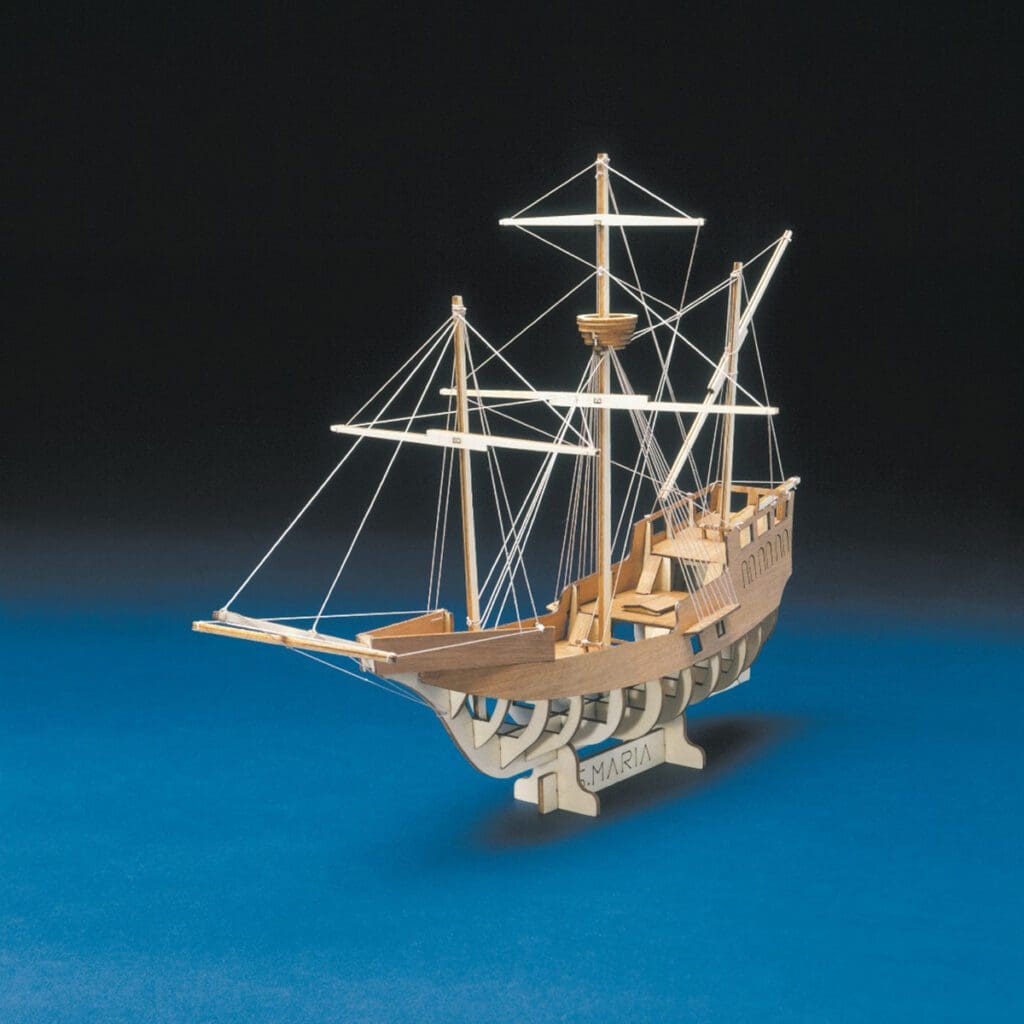
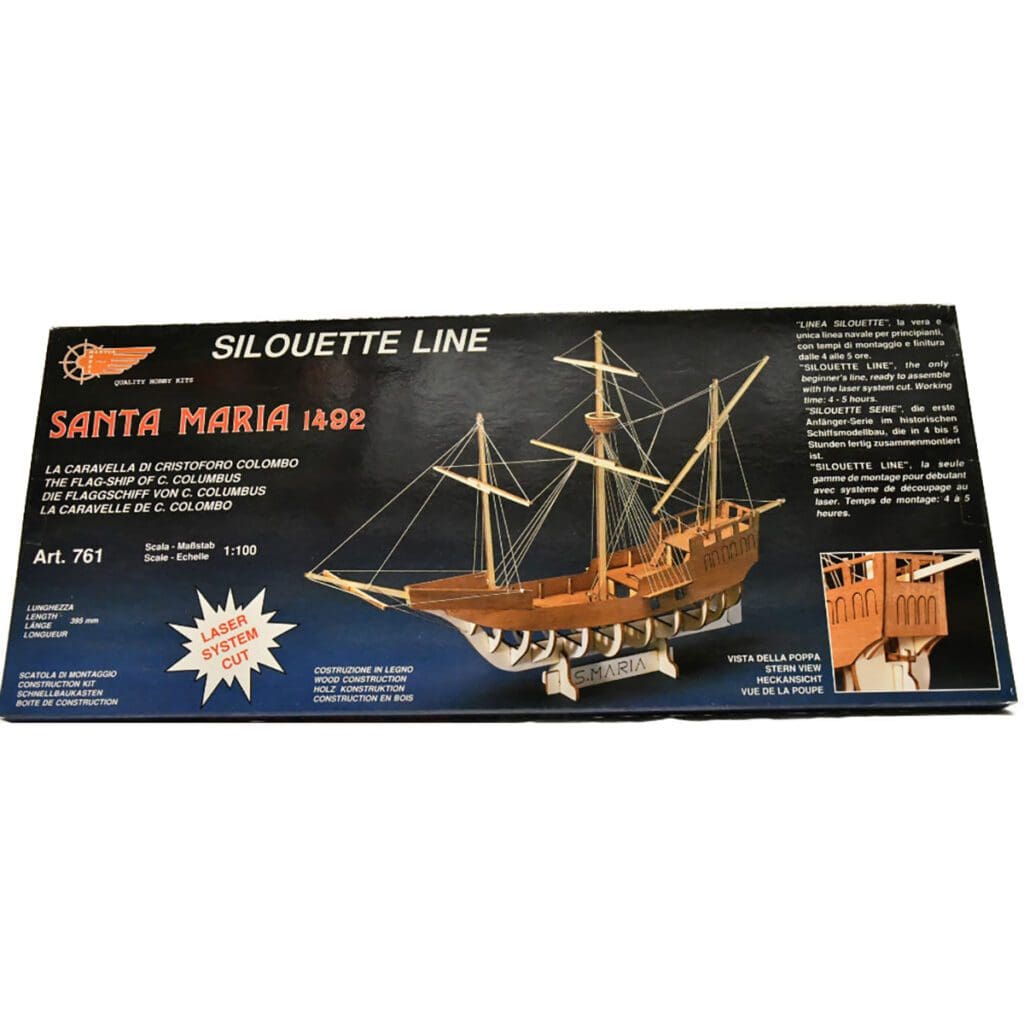
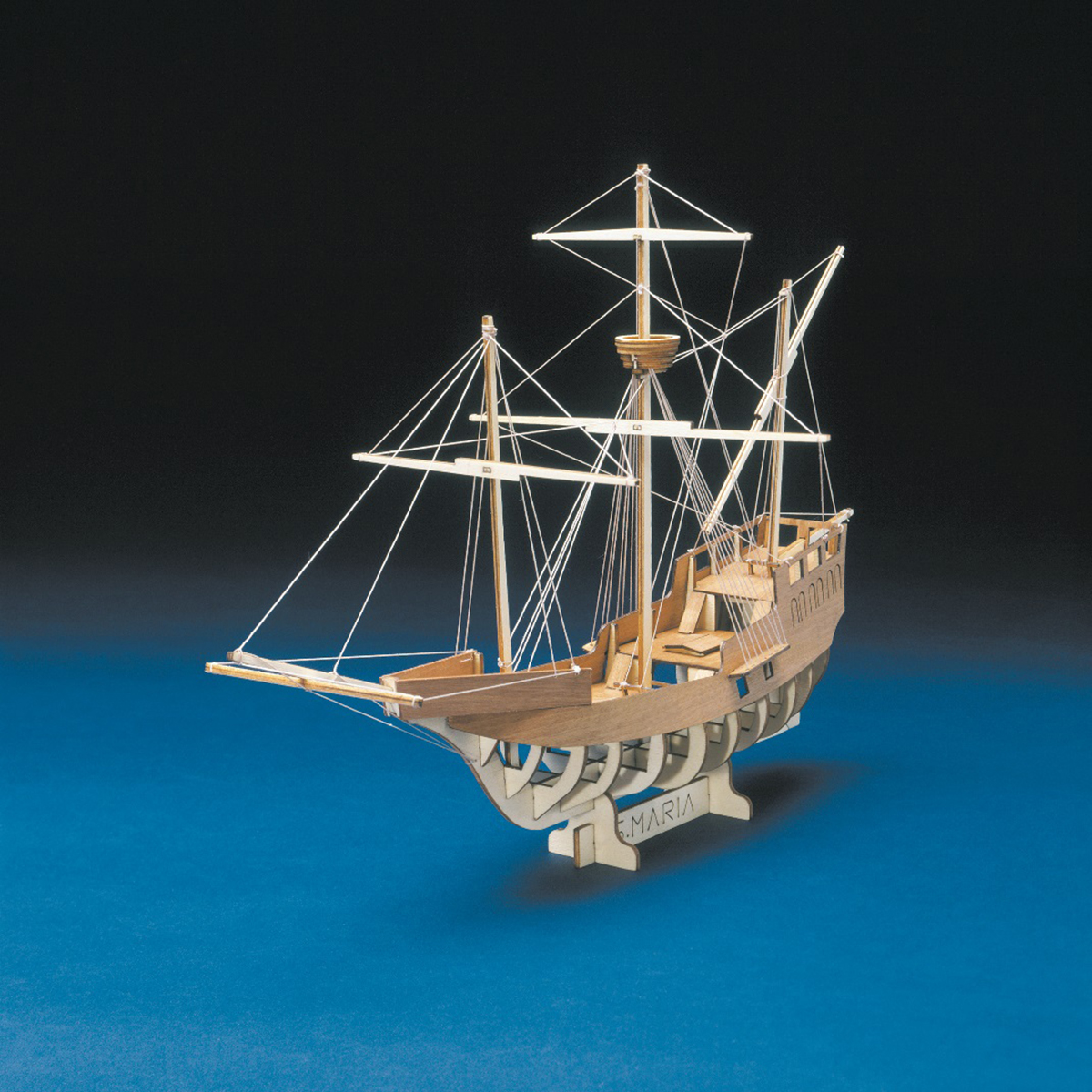
Technical details:
- DIMENSIONS: 39,5 cm
- SCALE: 1:100
- MATERIAL: wood
- PACKAGING: supplied in a cardboard box suitable for safe transport.
- DIFFICULTY LEVEL: *
- PRODUCT DESCRIPTION: Mantua offers a wide range of products. Building a silhouette model introduces the basics of hull construction and rigging. Thanks to their natural materials, completed Mantua models can rival the appearance of more complex models. The kit includes laser-cut components, rigging and photographs that guide you through the work step by step.
All you need is a hobby knife, glue and a few hours of free time.. - HISTORY: In 1492, Santa Maria was Columbus’s flagship when he set off into the unknown, hoping to reach India by sailing around the world. Instead, he discovered a new continent, America, although he never realised this during his lifetime. The ship was probably about 23 metres long and 7.8 metres wide. Apart from Noah’s Ark, Santa Maria, Christopher Columbus’s command ship, is undoubtedly one of the world’s best-known vessels. She sailed from Palos in southern Spain on 3 August 1492 with Pinta and Nina. The largest vessel was Columbus’s flagship, the 80-ton nao Santa Maria. Unfortunately, her precise appearance is unknown. To form an impression, we can read the account of Columbus’s life written by his contemporary Father Las Casas or study paintings of Flemish merchant ships from the late 15th century. On the way, Pinta was damaged near the Canary Islands. During repairs, her lateen rig was converted to a nao-style rig. On 6 September 1492, the ships headed west into the unknown sea. After thirty-five days of sailing, at two in the morning on 11 October, Rodrigo de Triana, keeping watch in Pinta’s masthead, sighted land. By morning they were off an island, which Columbus named San Salvador. Continuing southwest, he discovered Cuba and Haiti, naming the latter Hispaniola. Santa Maria ran aground there, so he left some of his men on Hispaniola and returned to Europe with the two remaining ships.
We recommend
Ideal for beginners: experience the satisfaction of building a real ship model and testing your skills without being discouraged by overly difficult tasks. Also suitable for experienced modellers: small modifications and more refined materials can produce highly sophisticated models. An imaginative gift for children: assembling a first model develops imagination, manual dexterity and precision. Valuable for schoolchildren: the materials offer excellent opportunities to develop practical skills.
Sorry, no reviews match your current selections