A magnetic compass has a freely turning magnetised needle that aligns with the horizontal component of the local Earth’s magnetic field. It helps identify directions, but magnetic north does not necessarily coincide with true north on a map. Correct interpretation depends on the instrument and its surroundings.
What do the degrees mean?
Bearings are measured clockwise from a north reference: north is 0° or 360°, east 90°, south 180° and west 270°. South-east, for example, is 135°. Every bearing needs a defined reference; a magnetic bearing may differ from a true bearing.
Magnetic north and true north
The angle between these directions is magnetic declination. It varies with location and changes over time. When using a map, consider its north references, the current local declination and the compass instructions together. The needle does not simply point at the geographical North Pole.
Basic steps for using a compass
- Hold the instrument as its manufacturer instructs, normally level for a conventional pocket compass.
- Move away from magnets, loudspeakers, large metal objects and electrical equipment. Allow the needle to settle.
- Identify the north-seeking end using the manufacturer’s markings. Needle colours are not identical across all models.
- Measure a target’s bearing with the sight or direction-of-travel indicator according to the model’s instructions. Do not turn the needle towards the target.
- When working with a map, use the appropriate north reference and correction.

What can affect a reading?
A magnetic phone case, car body or steel table can deflect the needle. Working without a battery does not guarantee accuracy in every situation. Movement, incorrect handling and local magnetic conditions also matter.
A gift compass or a navigation instrument?
Decorative brass models can make attractive nautical gifts. Their appearance alone does not establish suitability for accurate outdoor or marine navigation. Check the manufacturer’s intended use and specifications, and develop the necessary practical skills.

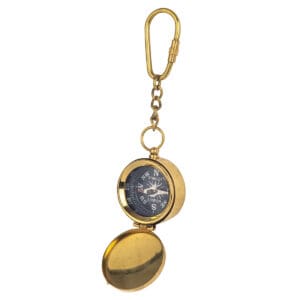
For a gift idea, explore the 4 cm brass compass with lid and keyring, listed in stock when checked on 24 October 2026. Check its product page for current availability.
Continue exploring traditional instruments with our articles on the sextant’s history and operation and how a sundial works.
Further reading
NOAA explains magnetic declination and how it varies.