Europe’s lighthouses bring together maritime history and an extraordinary variety of coastal landscapes. Set among dunes, at harbour entrances or on isolated rocks, each has its own architecture and story. This selection follows the twelve places in our original article, with updated historical details. Not every tower is open inside: check the operator’s current access, opening and travel information before planning a visit.
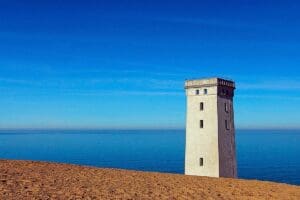
Rubjerg Knude, Denmark
On Jutland’s North Sea coast, sand dunes and coastal erosion have shaped this lighthouse’s story. Older predictions of its imminent destruction miss an important development: in October 2019, the tower was moved about 70 metres inland on rails to protect it from the retreating cliff. The landscape and the remarkable rescue make it a memorable landmark.
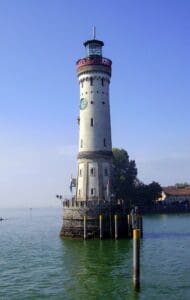
Lindau, Germany
At Lake Constance, Lindau’s harbour entrance is framed by the Bavarian lion and the New Lighthouse. Completed in 1856, the tower stands 36 metres high and is particularly recognisable for the clock on its façade. It is a reminder that striking navigational landmarks are not confined to the sea coast.
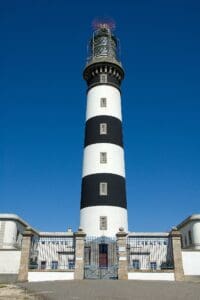
Phare du Créac’h, France
On the western side of Ouessant, also known as Ushant, the black-and-white Créac’h lighthouse is a distinctive Breton landmark. It stands beside an important shipping area where the Atlantic meets the English Channel. Tower access and museum arrangements can change, so check the local tourist office’s current information before planning a visit.
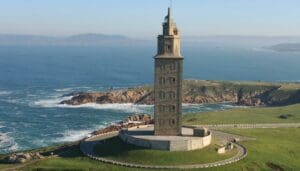
Tower of Hercules, Spain
Beside A Coruña in Galicia, the Tower of Hercules has Roman origins and a long continuity of maritime use. UNESCO dates its construction to the late first century AD; its Roman core survived an eighteenth-century restoration. This World Heritage site is remarkable for the connection it preserves between ancient engineering and maritime signalling.
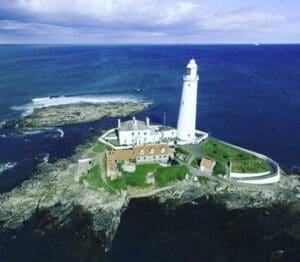
St Mary’s, England
Built in 1898 on a small tidal island near Whitley Bay, St Mary’s remained operational until 1984 and subsequently became a visitor centre. Its causeway is submerged at high tide. Access depends on the tide timetable, rather than simply on calm seas, so check the crossing conditions before setting out.
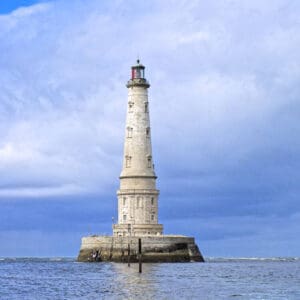
Cordouan Lighthouse, France
Cordouan rises from a rocky plateau at the mouth of the Gironde estuary in the Atlantic. Its elaborate architecture invites comparisons with a palace. Built around the turn of the sixteenth and seventeenth centuries, it was heightened in the late eighteenth century and inscribed on UNESCO’s World Heritage List in 2021. Visits require separate checks of sea crossings and tidal conditions.
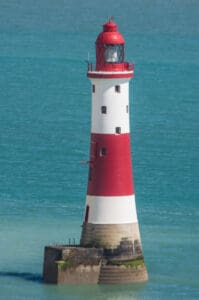
Beachy Head, England
The red-and-white tower stands offshore below the white cliffs of East Sussex. Trinity House records its construction in 1902, a tower height of 33 metres and automation in 1983. The contrast between the chalk cliffs and the lighthouse in the sea gives this stretch of coast its distinctive appearance.
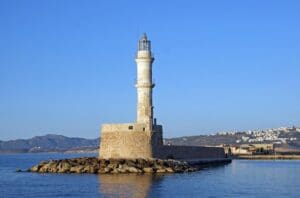
Chania, Greece
At the entrance to Chania’s old harbour, Venetian and Egyptian layers of history meet. The lighthouse’s familiar form is associated with its nineteenth-century Egyptian reconstruction. Seen from the harbour, the long breakwater and slender tower form one of Crete’s most recognisable townscapes.
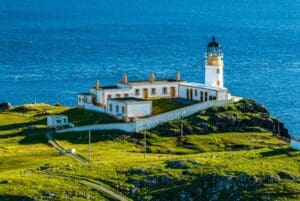
Neist Point, Scotland
Near Glendale on the western edge of Skye, Neist Point’s light was first exhibited on 1 November 1909. Its white tower is 19 metres high. The Northern Lighthouse Board lists no public access to the lighthouse itself, so plan around the coastal landscape and exterior views rather than an interior tour.
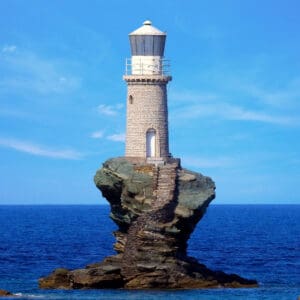
Tourlitis, Greece
Tourlitis stands on a separate rock off Chora on the island of Andros. Destroyed during the Second World War, the lighthouse was rebuilt with support from the Goulandris family. Its rock, stone steps and tower create an almost storybook silhouette.
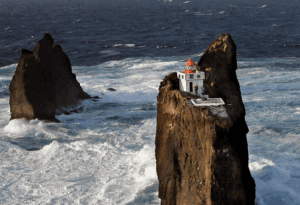
Þrídrangar, Iceland
Off Iceland’s south coast, Þrídrangar stands on a steep sea stack. In photographs, the rock dominates the scene: its height should not be confused with that of the small lighthouse building. This is not an ordinary, freely accessible sightseeing stop; its remote setting is what makes it so remarkable.
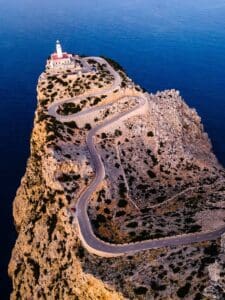
Formentor, Spain
At Mallorca’s northern tip, the rocky Formentor peninsula and the route to its lighthouse are part of the attraction. Seasonal traffic restrictions can affect access, so consult the local authority’s official information before travelling.
Bring the coastal atmosphere home
Explore our lighthouse decorations to recall the character of the coast. For more inspiration, read our nautical home decor ideas. If you need help choosing, contact us.